Tulio Honorio

Research

Each project links a mechanism observed at the scale of atoms or particles to a property engineers measure on concrete. The chart shows where each one sits.

Length scales covered by each project, from atoms (10⁻¹⁰ m) to structures (1 m), log scale.
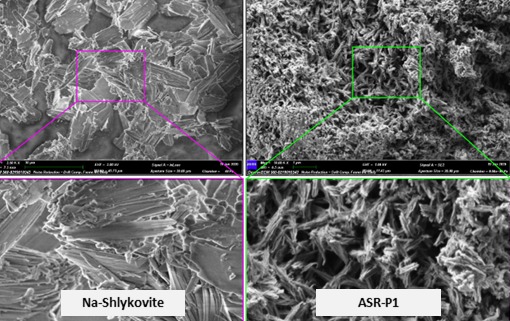
SEM images of synthesized ASR products, Na-shlykovite and ASR-P1
SEM images of synthesized ASR products: Na-shlykovite (Na₂O–SiO₂–CaO–H₂O system, left) and ASR-P1 (Na₂O–K₂O–SiO₂–CaO–H₂O system, right). Bottom: magnified views of the boxed areas.

Å → mm

Alkali–silica reaction

The alkali–silica reaction forms layered silicate products whose growth in confined pores damages concrete. We build atomic models of crystalline ASR products (shlykovite, kanemite, magadiite and related phases), derive their thermodynamic and thermoelastic data, and use them in phase diagrams and micromechanical estimates of crystallization pressure. Synthesis and NMR characterization of the products close the loop with experiments.

People
Elvys Dias Reis, Syrine Razki, Thibault Charpentier, Alexandra Bourdot, Farid Benboudjema
Funding
ANR/CEA – Mastering the expansion in ASR (PI), ANR HEAT COFFEE

Key papers

  1. Crystalline ASR products: review of mineral candidates and molecular simulations of their atomic structures, thermodynamic data and thermoelastic properties Honorio, T.; Razki, S.*; Dias Reis, E.#; Charpentier, T.; Loukili, I.***; Bourdot, A.; Benboudjema, F. Cement and Concrete Research 208, 108326 (2026) Open access doi:10.1016/j.cemconres.2026.108326
  2. Phase diagrams of ASR products from thermodynamic modeling Razki, S.*; Dias Reis, E.#; Bourdot, A.; Benboudjema, F.; Honorio, T. Cement and Concrete Research 207, 108287 (2026) Open access doi:10.1016/j.cemconres.2026.108287
  3. Crystallization pressure in ASR expansion quantified by thermodynamic modelling and micromechanics Razki, S.*; Benboudjema, F.; Bourdot, A.; Langlois, S.; Fau, A.; Hafid, F.; Honorio, T. Cement and Concrete Research 193, 107878 (2025) Open access doi:10.1016/j.cemconres.2025.107878
  4. Thermal properties of ASR products Honorio, T.; Razki, S.*; Bourdot, A.; Benboudjema, F. Materials and Structures 57 (5), 117 (2024) doi:10.1617/s11527-024-02388-w
  5. Atomic structure of nanocrystalline and amorphous ASR products Honorio, T.; Wei, W. Cement and Concrete Research 181, 107521 (2024) Open access doi:10.1016/j.cemconres.2024.107521
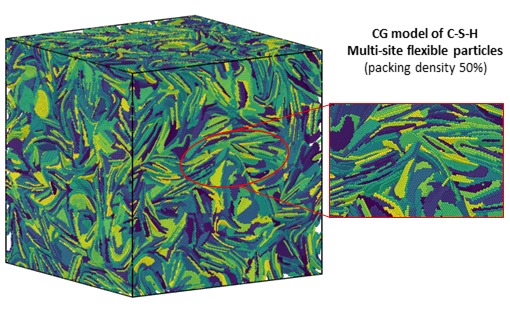
Coarse-grained model of the C-S-H gel with multi-site flexible particles
Coarse-grained model of the C-S-H gel built from multi-site flexible particles (packing density 50%), with a magnified view of the particle arrangement.

nm → µm

Coarse-grained C-S-H gel

The C-S-H gel is an assembly of nanometric, flexible particles whose arrangement controls the mechanics, creep and transport of cement paste. We represent these particles as flexible multi-site objects and simulate the resulting gel mesostructure with coarse-grained simulations, to link particle shape, flexibility and packing to the properties of the gel. The same approach applies to the gels formed by the alkali–silica reaction.

People
Sofiane Ait-Hamadouche

Key papers

  1. Nanomechanics of ASR gels from coarse-grained simulations Ait Hamadouche, S**; Honorio, T. Journal of Engineering Mechanics (2024) doi:10.1061/JENMDT/EMENG-6926

In preparation

  • Honorio, T. Mesostructure and properties of C–S–H gel from coarse-grained simulations with multi-site flexible particles.
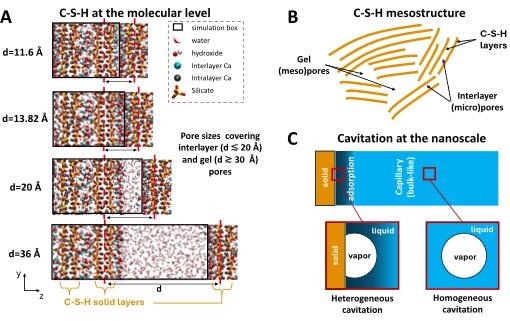
Molecular models of C-S-H pores from interlayer to gel pore sizes, C-S-H mesostructure and nanoscale cavitation
(A) Molecular models of C-S-H pores with sizes from 11.6 to 36 Å, covering interlayer and gel pores. (B) C-S-H mesostructure with interlayer (micro)pores and gel (meso)pores. (C) Heterogeneous and homogeneous cavitation at the nanoscale. From Masara, Benboudjema & Honorio, Langmuir (2024), ANR THEDESCO project.

Å → nm

C-S-H at the molecular scale

C-S-H is the main binding phase of concrete. We build and benchmark atomic models of C-S-H and use molecular simulations to compute its thermal, mechanical and transport properties, and to study the structure and dynamics of the water confined in its nanopores, including the subdiffusive water dynamics from which power-law creep emerges.

People
Fatima Masara, Farid Benboudjema, Naohiko Saeki
Funding
ANR THEDESCO

Key papers

  1. Power-law creep in C-S-H emerging from subdiffusive dynamics Honorio, T. Cement and Concrete Research 209, 108362 (2026) Open access doi:10.1016/j.cemconres.2026.108362
  2. Thermal, mechanical, and transport properties of C-S-H at the molecular scale: a force field benchmark Honorio, T.; Masara, F.*; Huang, G.#; Benboudjema, F. Cement 20: 100143 (2025) Open access doi:10.1016/j.cement.2025.100143
  3. Permeability of C-S-H Honorio, T. Cement and Concrete Research 176, 107408 (2024) doi:10.1016/j.cemconres.2023.107408
  4. Water self-diffusion in C-S-H: effect of confinement and temperature studied by molecular dynamics Honorio, T.; Carasek, H.; Cascudo, O. Cement and Concrete Research 155, 106775 (2022) doi:10.1016/j.cemconres.2022.106775
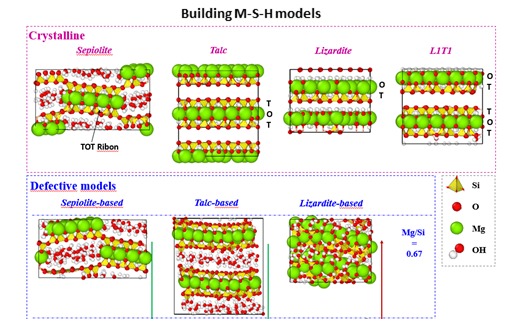
Crystalline and defective atomic models of M-S-H based on sepiolite, talc, lizardite and L1T1 structures
Building M-S-H models. Top: crystalline references (sepiolite, talc, lizardite, L1T1) with their TOT and OT layer stackings. Bottom: defective models derived from sepiolite, talc and lizardite at Mg/Si = 0.67. Si yellow, O red, Mg green, OH red and white.

Å → µm

M-(A)-S-H

Magnesium silicate hydrates (M-S-H) and their aluminium-bearing form M-A-S-H form in magnesium-based and low-carbon binders and in cement exposed to magnesium-rich environments, but their structure is poorly ordered and still debated. We synthesize M-(A)-S-H and characterize it experimentally, notably by NMR, and build atomic models starting from crystalline phyllosilicates (sepiolite, talc, lizardite) and introducing defects to match the measured composition. The resulting structures are used to compute elastic, thermal and transport properties with molecular simulations, as inputs for multiscale models.

People
Fatima Masara, Thibault Charpentier
Funding
CEA

In preparation

  • Masara, F.; Charpentier, T.; Honorio, T. M-S-H atomic structures.
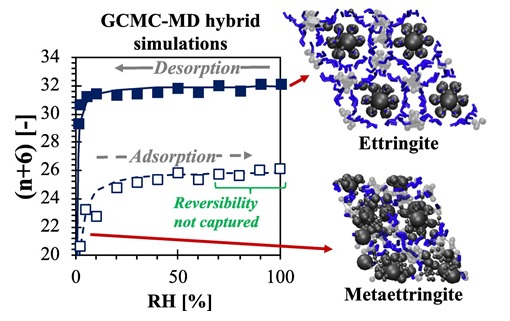
Water content of ettringite and metaettringite versus relative humidity from GCMC-MD simulations, showing sorption hysteresis
Sorption hysteresis in ettringite from hybrid GCMC-MD simulations: water content (n+6) versus relative humidity on desorption (ettringite) and adsorption (metaettringite), with the corresponding atomic structures. From Honorio, Maaroufi, Al Dandachli & Bourdot, Cement and Concrete Research (2021).

Å → mm

Sorption and sorption-induced deformation

Drying and wetting change the forces between the nanolayers of C-S-H, clays and other hydrates, causing shrinkage, swelling and hysteresis. We simulate sorption isotherms, disjoining pressures and cavitation in nanopores under varying humidity and temperature, and build poromechanical models that carry these effects up to the drying shrinkage and thermal deformation of concrete.

People
Fatima Masara, Farid Benboudjema, Laurent Brochard, Matthieu Vandamme, Elvys Dias Reis
Funding
ANR THEDESCO

Key papers

  1. Ettringite hysteresis under sorption from molecular simulations Honorio, T.; Maaroufi, M.; Al Dandachli, S.**; Bourdot, A. Cement and Concrete Research 150, 106587 (2021) doi:10.1016/j.cemconres.2021.106587
  2. Surface water in C-S-H: effect of the temperature on (de)sorption Honorio, T.; Masara, F.*; Poyet, S.; Benboudjema, F. Cement and Concrete Research 169, 107179 (2023) doi:10.1016/j.cemconres.2023.107179
  3. Why sorption hysteresis in tobermorite is limited Honorio, T.; Benboudjema, F. Asamato, S. Microporous and Mesoporous Materials 113205 (2024) Open access doi:10.1016/j.micromeso.2024.113205
  4. Revisiting thermo-poro-mechanics under adsorption: Formulation without assuming Gibbs-Duhem equation Brochard, L.; Honorio, T. International Journal of Engineering Science 152, 103296 (2020) doi:10.1016/j.ijengsci.2020.103296
All-atom PCE 40:10–25 molecule built with pyPCE
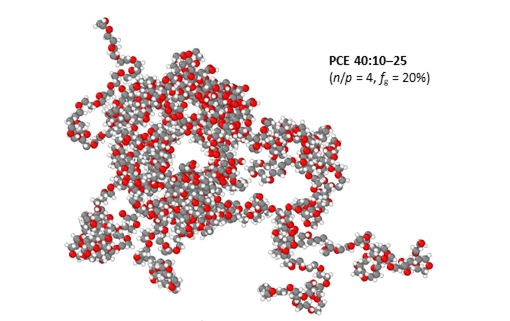
All-atom PCE 40:10–25 molecule (n/p = 4, f_g = 20%) built with pyPCE (OPLS-AA). C grey, O red, H white.

Å → nm

Superplasticizers (PCE)

Polycarboxylate ether (PCE) superplasticizers control the workability of modern concretes, including low-clinker mixes. We generate realistic all-atom PCE architectures and study their conformation and adsorption on cement and clay surfaces, as input to coarse-grained models of particle interactions and rheology. To build these molecules, we developed pyPCE, a Python tool that generates all-atom PCE models for LAMMPS (OPLS-AA) directly from their synthesis parameters: backbone length, grafting density, side-chain length, linkage chemistry and protonation state. An article presenting pyPCE is in preparation.

People
Ana Paula Kirchheim (UFRGS, Brazil)
Quartz atomic structure at irradiation doses of 0.1 and 2.5 eV/atom from ballistic cascade simulations
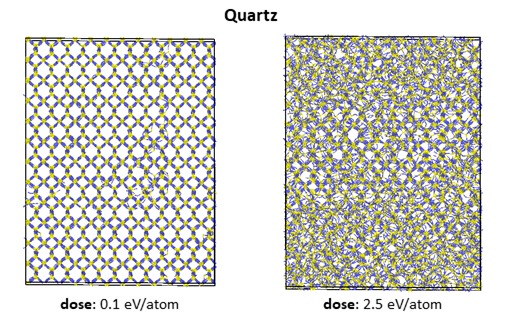
α-quartz after accumulated ballistic cascades at doses of 0.1 eV/atom (left, crystalline) and 2.5 eV/atom (right, amorphized), from ongoing ReaxFF molecular dynamics simulations.

Å → m

Irradiation effects in cement systems

Concrete in nuclear facilities is exposed to gamma and neutron radiation, which affects both the cement paste and the aggregates. In the hydrated paste, gamma radiation decomposes the water bound in and confined by hydrates, producing H₂; we study with molecular simulations how this hydrogen is released and transported, showing anisotropic, subdiffusive H₂ transport and the associated expansion in portlandite and other layered hydroxides. In the aggregates, neutron irradiation amorphizes the minerals and causes radiation-induced volumetric expansion (RIVE); we quantify it in quartz, feldspars, micas and inosilicates with ballistic cascade simulations using reactive force fields (ReaxFF). These results feed mesoscale simulations and simplified models of irradiated concrete.

People
Hazem Ferchichi, Abderrahmane Lahmar, Stéphane Poyet, Benoît Bary, Paul Fossati, Sophie Le Caër
Funding
CEA

Key papers

  1. H₂ anisotropic subdiffusion and induced expansion in portlandite, gibbsite and boehmite Honorio, T.; Trifa, M.***; Herin, T.; Le Caer, S. The Journal of Physical Chemistry C 128, 45, 19085–19097 (2024) doi:10.1021/acs.jpcc.4c04681
  2. Fractional subdiffusion of molecular hydrogen in irradiated portlandite: connecting atomistic insights and macroscopic release Simeone, D.; Herin, T.; Bouniol, P.; Poyet, S.; Honorio, T.; Le Caër, S. Physical Chemistry Chemical Physics (2026) doi:10.1039/D6CP02999J
Na-montmorillonite at 1W, 1.5W, 2W and 3W hydration states
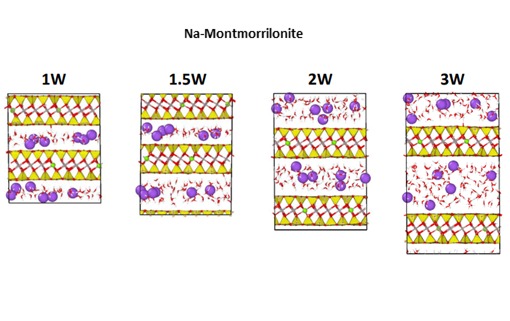
Molecular models of Na-montmorillonite at increasing hydration: one-, one-and-a-half-, two- and three-layer hydrates (1W, 1.5W, 2W, 3W). Clay layers in yellow and red, Na⁺ counterions in purple, interlayer water in red and white.

Å → nm

Water and ions in clays

Swelling clays confine water and ions in nanometric interlayers. We show that their transport is subdiffusive and describe it with fractional diffusion laws, and we study how counterions control disjoining and swelling pressure. The same framework explains anomalous thermal pressurization and heat capacity in clays.

People
Laurent Brochard, Matthieu Vandamme

Key papers

  1. Anomalous diffusion of water and ions in swelling clays Honorio, T. The Journal of Physical Chemistry C (2026) doi:10.1021/acs.jpcc.6c05692
  2. Drained and undrained heat capacity of swelling clays Honorio, T.; Brochard, L. Physical Chemistry Chemical Physics 24, 15003-15014 (2022) Open access doi:10.1039/D2CP01419J
  3. Flexibility of nanolayers and stacks: implications in the nanostructuration of clays Honorio, T.; Brochard, L.; Vandamme, M.; Lebée, A. Soft Matter 14, 7354-7367 (2018) doi:10.1039/C8SM01359D
  4. Hydration phase diagram of clays from molecular simulations Honorio, T.; Brochard, L.; Vandamme, M. Langmuir 33 (44), 12766-12776 (2017) doi:10.1021/acs.langmuir.7b03198
  5. Nanoscale origin of the thermomechanical behavior of clays Brochard, L.; Honorio, T.; Vandamme, M.; Bornert, M.; Peigney, M. Acta Geotechnica 12 (6), 1261-1279 (2017) doi:10.1007/s11440-017-0596-3
Impedance of the C-S-H gel versus frequency for increasing packing density, with equivalent circuits
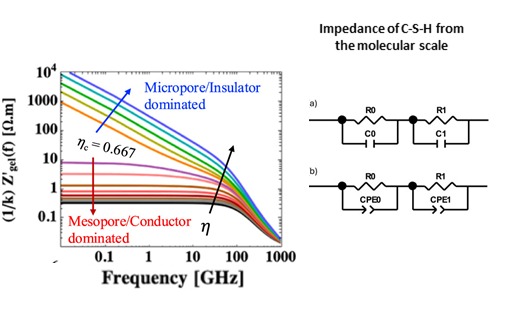
Impedance of C-S-H from the molecular scale, upscaled with micromechanics: real part of the gel impedance versus frequency for increasing packing density η. Below the threshold η_c ≈ 0.667 the response is dominated by mesopores (conductor), above it by micropores (insulator). Right: equivalent circuits with (a) capacitors and (b) constant-phase elements. From Honorio, Bonfim & Cascudo, Cement and Concrete Research (2026).

Å → m

Electrical and dielectric properties

Electrical and dielectric measurements are non-destructive ways to follow hydration, moisture and degradation in concrete. We compute the dielectric permittivity and ionic conductivity of pore solutions and hydrates from molecular simulations, and upscale them with micromechanics to interpret impedance and microwave measurements on cement pastes and concrete.

People
Sofiane Ait-Hamadouche, Walter Batista Bonfim, Oswaldo Cascudo, Helena Carasek, Éric Vourc'h, Thierry Bore
Funding
IDEX LaSIPS (HYDRA)

Key papers

  1. Impedance and ionic conductivity of C-S-H Honorio, T.; Bonfim, W.B.*; Cascudo, O. Cement and Concrete Research 201, 108123 (2026) Open access doi:10.1016/j.cemconres.2025.108123
  2. Dielectric permittivity of C-S-H Ait Hamadouche, S*; Honorio, T.; Bore, T.; Benboudjema, F.; Daout, F.; Vourc'h, E. Cement and Concrete Research 169, 107178 (2023) doi:10.1016/j.cemconres.2023.107178
  3. Monitoring of Mortar Hydration Combining Microwave and Calorimetry Measurements Ferhat, M.*; Honorio, T.; Bore, T.; Benboudjema, F.; Daout, F.; Vourc'h, E. IEEE Transactions on Instrumentation & Measurement 72, 1-11, 2023, 6002811 (2023) doi:10.1109/TIM.2023.3256462
  4. Electrical properties of cement-based materials: Multiscale modeling and quantification of the variability Honorio, T.; Carasek, H.; Cascudo, O. Construction and Building Materials 245, 118461 (2020) doi:10.1016/j.conbuildmat.2020.118461
  5. Dielectric properties of the pore solution in cement-based materials Honorio, T.; Bore, T.; Benboudjema, F.; Vourc'h, E.; Ferhat, M* Journal of Molecular Liquids 302, 112548 (2020) doi:10.1016/j.molliq.2020.112548
  6. The pore solution of cement-based materials: structure and dynamics of water and ions from molecular simulations Honorio, T.; Benboudjema, F.; Bore, T.; Ferhat, M.*; Vourc'h, E. Physical Chemistry Chemical Physics 21, 11111-11121 (2019) doi:10.1039/C9CP01577A
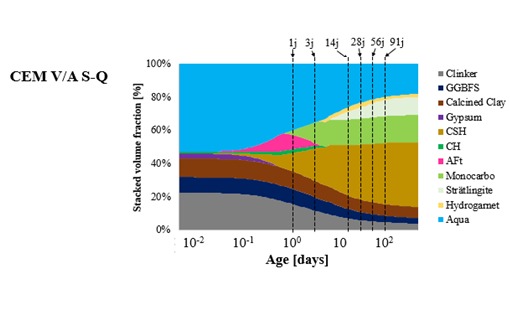
Phase assemblage of a CEM V/A S-Q blended cement paste versus age from thermodynamic modelling
Phase assemblage of a CEM V/A (S-Q) cement paste (slag and calcined clay) as a function of age, from thermodynamic modelling with CemGEMS (stacked volume fractions, w/c = 0.4). Dashed lines mark the ages of mechanical testing. From Honorio, TINCE 2026.

nm → m

Low-carbon concrete

Blended cements with limestone, slag and calcined clays are replacing clinker, but the number of possible binder combinations is too large to test experimentally. We compute the phase assemblages of commercial blended cements over time with thermodynamic modelling, and use them as input to micromechanical homogenization to predict Young's modulus and compressive strength without characterizing each binder in detail. An ongoing experimental campaign on cements from the French market measures their mechanical properties to validate and extend this binder-agnostic approach. Related work covers new hydrates such as M-(A)-S-H and the electrical response of C-S-H for non-destructive monitoring.

People
Nathan Martins, Fatima Masara, Walter Batista Bonfim, Oswaldo Cascudo, Thibault Charpentier
Funding
CEA–EDF–Framatome tripartite agreement

Key papers

  1. Impedance and ionic conductivity of C-S-H Honorio, T.; Bonfim, W.B.*; Cascudo, O. Cement and Concrete Research 201, 108123 (2026) Open access doi:10.1016/j.cemconres.2025.108123
  2. Effects of relative humidity on dissolution and carbonation potential of portlandite Saeki, N.*; Maruyama, I.; Honorio, T. Langmuir 42 (9), 6745–6760 (2026) Open access doi:10.1021/acs.langmuir.5c05760
  3. Machine Learning and Micromechanics as Allies to Correlate Composition-Property in Cement-Based Materials Honorio, T.; Ait Hamadouche, S**; Fau, A. Journal of Theoretical, Computational and Applied Mechanics (2023) Open access doi:10.46298/jtcam.9830

Conference paper

  • Honorio, T. Blended low carbon binders: composition–property correlations for elastic constants and compressive strength. TINCE 2026 (submitted).
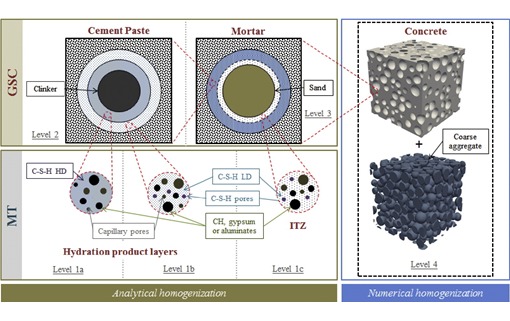
Multiscale homogenization scheme from hydration products to cement paste, mortar and concrete
Multiscale representation of concrete for estimating its ageing viscoelastic properties: analytical homogenization (Mori–Tanaka, MT, and generalized self-consistent, GSC, schemes) from hydration product layers to cement paste and mortar (levels 1–3), and numerical homogenization at the concrete scale with coarse aggregates (level 4). From Honorio, Bary & Benboudjema, Cement and Concrete Research (2016).

nm → m

Micromechanics and upscaling

Micromechanics is the bridge between the molecular scale and the engineering scale in our work. We develop analytical and numerical homogenization schemes (Mori–Tanaka, self-consistent, n-coated sphere assemblages) to estimate the elastic, ageing viscoelastic, thermal, thermo-poro-elastic, transport and electrical properties of cement-based materials from their phase assemblage and microstructure. These schemes take inputs from molecular simulations and thermodynamic modelling, quantify the variability of local fields, and are compared with full-field simulations, experiments and international benchmarks.

People
Tulio Honorio

Key papers

  1. Effective properties of n-coated composite spheres assemblage in an ageing viscoelastic framework Honorio, T.; Bary, B; Sanahuja, J.; Benboudjema, F. International Journal of Solids and Structures 124, 1-13 (2017) doi:10.1016/j.ijsolstr.2017.04.028
  2. Thermal properties of cement-based materials: multiscale estimations at early-age Honorio, T.; Bary, B; Benboudjema, F. Cement and Concrete Composites 87, 205-219 (2018) doi:10.1016/j.cemconcomp.2018.01.003
  3. Homogenization of nonaging basic creep of cementitious materials: a multiscale modeling benchmark Königsberger, M.; Honorio, T; Sanahuja, J.; Delsaute, B.; Pichler, B. L. A. Construction and Building Materials 290, 123144 (2021) doi:10.1016/j.conbuildmat.2021.123144